






Downhole sand control remains one of the most persistent threats to your systems well stability and long-term performance. When formation solids migrate with produced fluids, they can erode completion equipment, restrict flow paths, and destabilize the near-wellbore environment. In many cases, these issues don’t appear immediately but develop over time as reservoir conditions shift, drawdown changes, or fines distribution evolves, turning what initially looks like a successful completion into a costly intervention.
Achieving consistent sand control in these conditions depends heavily on how the screening media itself is designed. Screens must provide reliable sand retention without compromising flow efficiency even as pressure, temperature, and fluid composition fluctuate. This is why sinter bonded woven wire media such as POROSTAR has become an increasingly important option in downhole applications, offering a controlled pore structure and structural integrity that supports stable performance where conventional single-layer or slot-based designs can struggle.
At W.S. Tyler, we approach sand control as building solutions that support cleaner, safer processes throughout the life of the well. With more than 150 years of experience engineering woven wire technologies, we focus on precision manufacturing and consistency to help operators manage complex downhole conditions with confidence. That experience informs how our laminated wire designs are developed, tested, and applied in demanding oil and gas environments.
In this article, we’ll explore what makes downhole stability such a challenge in sand control applications, how woven wire laminates are engineered to address those challenges, and how balancing mechanical strength with filtration accuracy plays a critical role in long-term performance. We’ll also take a closer look at how POROSTAR wire mesh media supports stable sand control without sacrificing flow, providing insight into why thoughtful media design matters below the surface.
The Challenge of Downhole Stability
Downhole stability is difficult to maintain because sand control systems operate in an environment that is anything but static. Reservoir depletion, changing drawdown, and shifting stress around the wellbore can all alter how formation sand behaves over time. As production continues, grains that were once stable can begin to mobilize, increasing the risk of fines migration, erosion, or partial screen blockage.
These changes place continuous mechanical and hydraulic stress on sand control media, especially in wells producing from unconsolidated or weakly cemented formations.
One of the core design challenges is uncertainty in formation sand characteristics. Particle size distribution is rarely perfectly uniform across a producing interval, and fines content can increase as reservoirs age or water breakthrough occurs. Screens designed around a narrow particle size window may perform well initially but lose effectiveness when finer particles begin to move, leading to plugging or accelerated pressure drop. Variability, rather than absolute sand size, is a major driver of long-term sand control issues, particularly in high-rate or extended-reach wells.
Mechanical loads further complicate the picture. Downhole screens must withstand collapse forces, axial loads during installation, vibration from flow, and exposure to corrosive fluids, all while maintaining consistent filtration performance.
Designs that lack sufficient structural support or rely on isolated load paths can deform under these conditions, changing pore geometry and reducing sand retention accuracy. This is why stability in sand control is about designing screening media that can maintain its shape, pore structure, and performance throughout the life of the well.
How Woven Wire Laminates Improve Stability
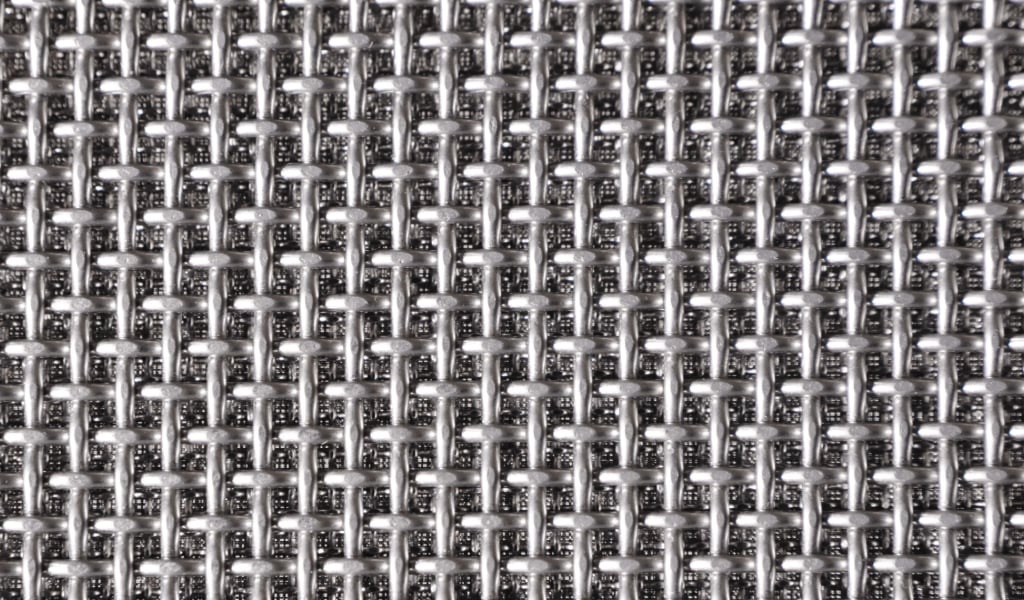
Woven wire laminates are designed to address one of the biggest weaknesses of traditional sand control media: inconsistency under load. Unlike single-layer mesh or slot-based screens, laminated designs use multiple woven layers that are sinter bonded together to create a stable, unified structure.
This manufacturing approach distributes mechanical stress across the entire media rather than concentrating it at individual wires or weld points, helping the screen maintain its geometry when exposed to high differential pressures and fluctuating flow rates.
Wire mesh laminates also provide a tightly controlled and repeatable pore structure. Because woven wire layers are produced with precise wire diameters and spacing, laminates can deliver uniform openings across the entire screen surface.
This consistency is critical in downhole environments where sand size distribution is rarely uniform and can change as the reservoir depletes. Stable pore geometry reduces the likelihood of localized plugging or channeling, allowing filtration performance to remain predictable even when fines content increases over time.
Looking to discover the differences between woven wire mesh laminates and other media used in sand control? Read the article below to learn more:
Laminated wire mesh media also improves hydraulic stability by balancing open flow area with structural support. In downhole screens, excessive deformation or wire movement can alter flow paths, increasing velocity in localized areas and accelerating erosion. Laminates minimize this risk by embedding the filtration layer within supporting layers that resist movement and vibration.
The result is a screen that supports smooth, evenly distributed flow while protecting the filtration surface from damage during both installation and long-term production.
Just as importantly, woven wire laminates are well-suited for environments where long-term reliability matters more than short-term flow gains. By maintaining pore size accuracy and structural integrity over time, these designs help operators reduce sand breakthroughs, protect downstream equipment, and extend well life. Instead of relying on one design feature to do everything, laminates combine filtration precision and mechanical stability in a way that aligns with real-world downhole conditions where change is inevitable, and consistency is essential.
Balancing Strength and Filtration with POROSTAR
Achieving reliable sand control downhole demands a careful balance between mechanical strength and filtration precision. POROSTAR woven wire laminates are engineered specifically to manage this tradeoff by combining multiple layers of woven wire into a sinter bonded structure that resists deformation while maintaining a defined pore geometry.
This layered construction allows the filtration layer to remain protected and dimensionally stable even when exposed to high differential pressures, axial loads, and dynamic flow conditions common in producing wells.
One of the key advantages of POROSTAR is how it handles variable and evolving sand sizes. In many reservoirs, particle size distribution changes over time as drawdown increases or fines begin to mobilize near the wellbore. POROSTAR’s uniform and repeatable pore structure helps reduce sensitivity to these shifts by limiting localized flow acceleration and minimizing the risk of uneven plugging.
Instead of relying on large slots or unsupported openings, the multi-layer design promotes consistent filtration across the entire screen surface, supporting stable production rates over a longer period.
Strength is just as critical as filtration accuracy in downhole environments. Screens that flex, ovalize, or fatigue under load can experience changes in pore size that compromise sand retention. POROSTAR addresses this by distributing mechanical loads across bonded wire layers, rather than concentrating stress at individual welds or contact points. This load-sharing behavior improves resistance to vibration, erosion, and long-term mechanical fatigue, which are factors that are frequently cited in premature screen failures in high-rate or extended-reach wells.
By maintaining both structural integrity and filtration control, POROSTAR supports a more predictable sand control strategy that aligns with real-world downhole conditions rather than idealized reservoir assumptions. The result is a screening media that helps operators protect completion equipment, reduce intervention risk, and maintain steady flow without overengineering the solution. That balance is what makes laminated woven wire media a practical choice for sand control designs focused on long-term stability rather than short-term gains.
Designing Sand Control That Lasts
Downhole sand control is ultimately a long-term reliability challenge. As reservoirs evolve and operating conditions change, stability depends on how well screening media can maintain both its structural integrity and filtration accuracy. Throughout this article, we’ve looked at why downhole stability is difficult to sustain, how woven wire laminates address those challenges, and how engineered solutions like POROSTAR help balance strength and sand retention in demanding environments.
For operators and completion designers, the next step is taking a closer look at how screening media behaves over time and not just at startup. Evaluating sand size variability, expected drawdown changes, mechanical loading, and flow conditions early in the design process helps ensure the selected sand control solution aligns with actual well life expectations. Media that maintains pore structure and resists deformation can play a meaningful role in reducing intervention risk and protecting downstream equipment.
At W.S. Tyler, our focus remains on supporting cleaner and safer processes by applying generations of woven wire expertise to real-world challenges. With more than 150 years of experience engineering precision wire solutions, we understand that performance below the surface depends on consistency, durability, and thoughtful design; not shortcuts or assumptions about ideal conditions.
Looking to discover more about the various problems that can occur in your sand control system? Read the article below to learn more: