




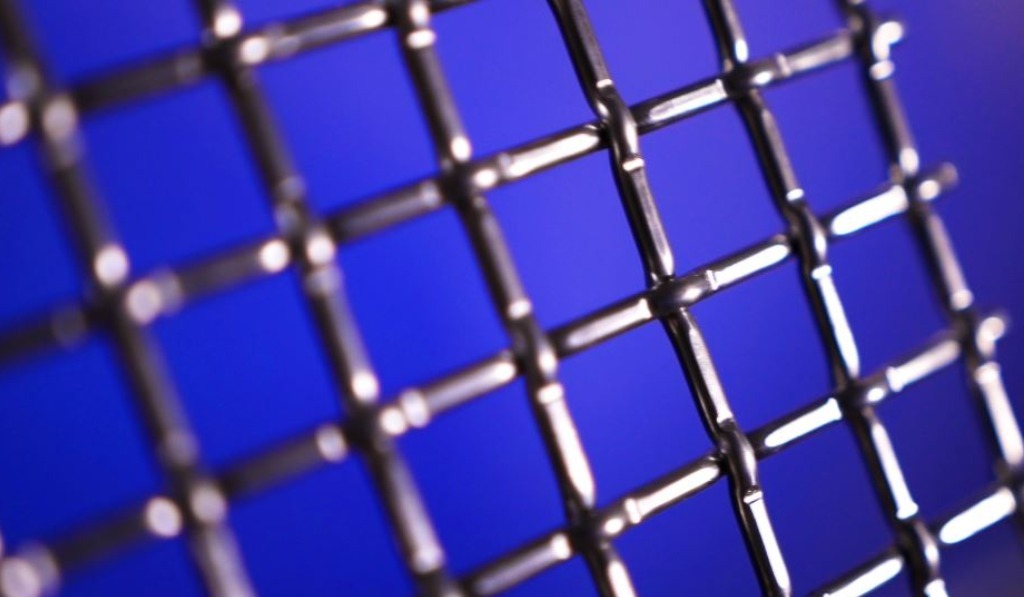


When molded pulp operations begin to struggle with inconsistent part quality, rising scrap rates, or unexplained downtime, attention often turns to upstream variables like furnish composition, vacuum setting, or forming pressures. What’s frequently overlooked is that woven wire mesh screens are already recording those issues in real time. Wear patterns, thinning, and localized damage don’t happen randomly, as they are physical responses to how the system is behaving.
In molded pulp and fiber applications, woven wire mesh sits at the intersection of flow, fiber, and vacuum. As pulp moves across the screen, changes in furnish, uneven vacuum distribution, or chemical exposure show up first on the mesh surface. Areas experiencing excessive abrasion, premature corrosion, or irregular loading often point directly to upstream process imbalances long before they trigger alarms or quality failures.
At W.S. Tyler, we’ve spent more than 150 years working with woven wire solutions designed to support cleaner, safer industrial processes. That experience has shown us one consistent truth: screens do more than separate and dewater, as they provide valuable insight into system health when you know how to read them. Understanding wear is not about pushing mesh longer than it should run, but instead it’s about using observable data to improve performance across the entire pulp process.
This article breaks down how to interpret common woven wire mesh wear patterns in molded pulp systems, what those patterns reveal about furnish changes, flow dynamics, and vacuum distribution, and how to distinguish mechanical wear from chemical attack. We’ll also explore how screen inspections can be used as a practical diagnostic tool and most importantly, how wear observations can be turned into targeted process corrections that improve pulp stability and product consistency.
What Different Mesh Wear Patterns Indicate
Woven wire mesh wear in molded pulp systems is rarely uniform, and that unevenness is often the most valuable clue. Different wear patterns form based on how fiber, water, vacuum, and chemistry interact with the screen surface. By understanding what these patterns typically signal, operators can move beyond treating mesh as a consumable and begin using it as a process indicator.
One of the most commonly observed patterns is localized abrasion, where thinning or polishing appears in specific zones rather than across the entire screen. This type of wear usually points to mechanically driven causes such as elevated flow velocity, fiber bundles repeatedly contacting the same area, or directional slurry movement during forming. In molded pulp applications, it can also indicate uneven furnish dispersion, where coarse fibers or contaminants preferentially impact certain regions of the mesh rather than being evenly distributed.
In contrast, uniform thinning across the mesh surface often suggests global operating conditions rather than localized mechanical issues. Higher than normal solids loading, extended run times without adequate cleaning, or increased forming pressure can gradually rescue wire diameter across the entire screen. While this wear is expected over time, accelerated uniform thinning may indicate that forming parameters are being pushed beyond what the mesh was designed to handle.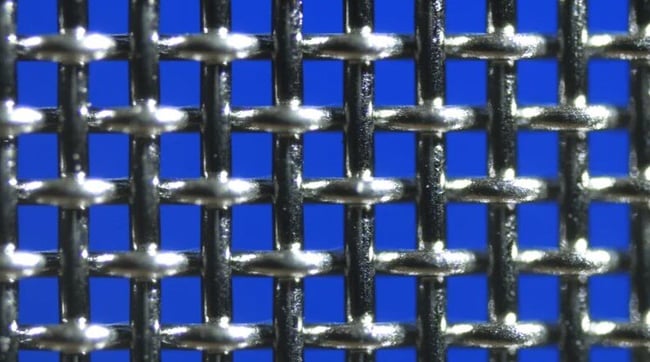
Another distinct category is chemical driven wear, which typically presents as pitting, discoloration, or surface roughening rather than smooth abrasion. Stainless steel meshes exposed to aggressive pH conditions, oxidizing agents, or repeated chemical cleaning cycles may show these effects well before mechanical wear becomes visible.
Unlike abrasion, chemical attack often alters the surface texture of the wire, which can reduce drainage efficiency and fiber release even when wire diameter remains within tolerance.
Finally, edge and transition-zone damage such as broken wires at screen borders or around attachment points often reflect stress concentration rather than process imbalance. However, repeated failures in the same locations can signal excessive vibration, pressure cycling, or misalignment elsewhere in the system. These patterns are important to note, but they should be interpreted differently than wear occurring in active forming areas.
Abrasion, chemical degradation, and stress-related damage each tell a different story about what’s happening upstream. When wear patterns are evaluated with process conditions in mind, the screen becomes a readable map of how the pulp system is truly operating.
How Uneven Flow and Vacuum Show Up as Mesh Wear
In molded pulp systems, it’s rare for flow and vacuum to be perfectly balanced across the entire screen surface. Small distribution issues are often unavoidable, but when those imbalances become significant, woven wire mesh is usually the first component to show it. The location, severity, and shape of wear patterns can provide valuable clues about how slurry and vacuum are actively behaving inside the system, not just how they’re set on paper.
One of the most telling indicators is zone-specific wear, where certain areas of the mesh thin or polish significantly faster than others. This type of damage often corresponds with uneven slurry delivery or preferential flow paths. When pulp consistently enters the forming zone with higher velocity in one direction, fibers repeatedly impact the same mesh region, increasing localized abrasion. Over time, this creates visible wear “hot spots” that align closely with flow entry points or directional movement across the screen.
Vacuum distribution plays an equally important role. Areas experiencing higher effective vacuum tend to see increased mechanical stress as fibers are pulled more aggressively against the mesh surface. This can accelerate wire thinning, especially in fine mesh constructions where contact pressure is higher. Conversely, regions with weak or inconsistent vacuum may show reduced wear but poorer drainage, leading to fiber buildup or uneven mat formation, which are issues that often prompt operators to increase pressure or vacuum elsewhere, inadvertently worsening wear in already stressed areas.
Looking to learn more about why mesh count isn’t one-size-fits all for your system? Read the article below to discover more:
Another common indicator is asymmetrical wear across patterned or multi-zone screens. When vacuum zones are not balanced or when manifolds are partially restricted, wear may track along specific rows or sections of the mesh. These patterns don’t develop randomly; they mirror the pressure gradients acting on the screen during forming.
In many cases, the wear outlines the exact footprint of uneven vacuum draw, making the mesh a physical record of distribution problems that are otherwise difficult to measure directly.
What makes these observations especially valuable is timing. Changes in flow balance or vacuum efficiency often show up on the mesh before they create visible part defects or trigger instrumentation alarms. By paying attention to where wear initiates and how it spreads, processors can identify developing issues early and adjust manifold design, vacuum zoning, or slurry delivery to restore balance, reducing both screen damage and downstream instability.
Using Woven Wire Mesh as a Diagnostic Tool
Once wear patterns are understood and linked to flow, vacuum, and chemistry, woven wire mesh can be used internationally as a diagnostic surface rather than a passive component. In molded pulp systems, the screen is one of the few elements that directly interacts with furnish, water, pressure, and vacuum simultaneously, making it a reliable indicator of upstream behavior when inspected correctly.
Effective diagnostics begin with consistent inspection practices. Comparing screens only at end-of-life often masks early indicators that could have been addressed sooner. Tracking where wear initiates, how quickly it progresses, and whether it remains localized or spreads across the mesh provides context that single-point inspections cannot. Even short run comparisons between similar screens can reveal whether changes in wear are process driven or simply related to normal operating variability.
Differentiating mechanical wear from chemical attack is a critical part of this process. Mechanical abrasion typically results in smooth wire thinning and directional wear marks tied to slurry movement or fiber contact. Chemical exposure, by contrast, tends to alter surface finish through pitting, etching, or discoloration and may appear disproportionately in areas exposed to cleaning chemistry or extreme pH. Identifying the dominant wear mechanism helps determine whether corrective action should focus on process mechanics, chemical control, or material selection.

Mesh diagnostics also become more powerful when paired with process adjustments and validation. For example, if wear patterns suggest uneven vacuum draw, adjustments to vacuum zoning or manifold balance can be made and then verified through subsequent screen inspections. When wear stabilizes or becomes more uniform following a change, the mesh provides confirmation that the correction addressed the root cause rather than just the symptom.
Perhaps most importantly, using mesh as a diagnostic tool shifts maintenance and process discussions from reactive to proactive. Screens are no longer viewed only as components that fail, but as measurement surfaces that provide feedback without additional instrumentation. When operators, engineers, and maintenance teams share a common understanding of what wear patterns indicate, woven wire mesh becomes an active contributor to process stability rather than a recurring cost.
Applying Wear Insights to Improve Pulp Stability
Woven wire mesh wear is a visible record of how your molded pulp system is actually operating. By paying attention to where wear occurs, how it develops, and what form it takes, processors can gain insight into furnish behavior, flow balance, vacuum effectiveness, and chemical exposure without adding complexity to the operation.
The most important improvements come when wear observations are translated into intentional process adjustments. Addressing uneven flow paths, rebalancing vacuum distributions, stabilizing furnish consistency, or refining cleaning chemistry can reduce abnormal wear while improving forming consistency at the same time. When changes are made based on what the mesh is indicating, screen performance and pulp stability tend to improve together rather than in isolation.
At W.S. Tyler, we’ve spent more than 150 years helping operators support cleaner, safer, and more reliable processes through woven wire solutions. That experience reinforces an important principle: when screens are understood, not just replaced, they become part of a smarter operating strategy, which is one that reduces guesswork and supports long-term process control.
Want to learn more about the best practices to keep your molded pulp operation running smoothly? Read the article below to discover more: