




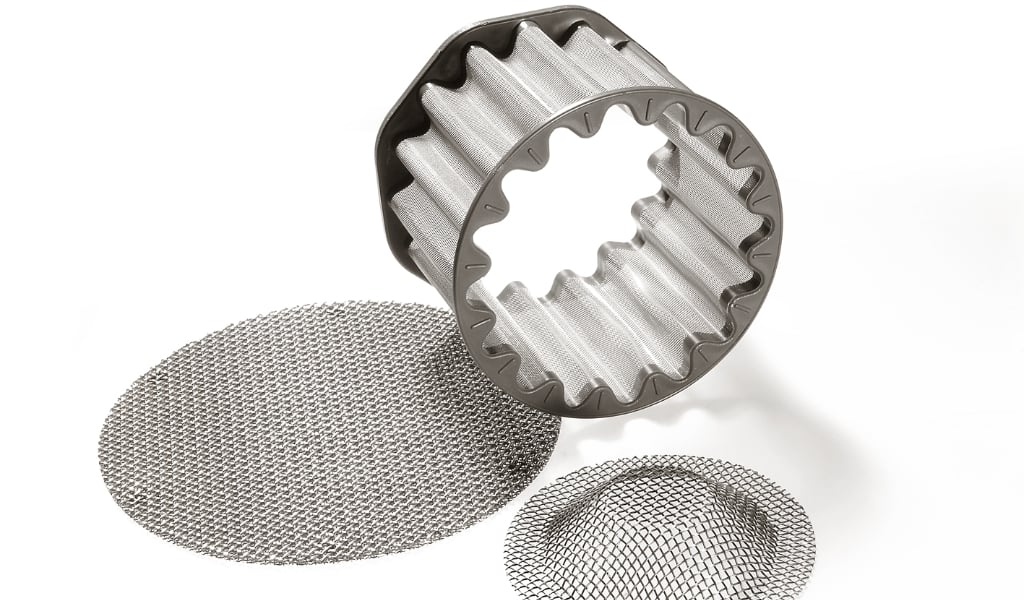


Microplastic contamination has become one of the fastest-growing concerns in water treatment, as these particles are now being found across oceans, rivers, drinking water systems, and even human tissue. Smaller microplastics often pass through conventional filtration methods, allowing them to circulate through water facilities and industrial systems unchecked. This has created significant operational, environmental, and health-related pressure for municipalities, manufacturers, and filtration engineers seeking to minimize microplastic exposure and improve water quality standards.
To meet these new demands, filtration systems must rely on media that can maintain stable performance, capture smaller particles, withstand harsh environments, and remain cost-efficient long term. Stainless steel woven wire mesh meets all of these challenges thanks to its durability, chemical and thermal resistance, precision pore geometry, and its ability to be cleaned and reused repeatedly. These properties help stainless steel mesh to excel in applications where synthetic filter media may degrade, clog, or require frequent replacement, which are issues widely noted with synthetic filters.
At W.S. Tyler, we’ve spent over 150 years engineering woven wire mesh solutions that help customers build cleaner, safer, and more reliable filtration systems. As microplastic research accelerates and global standards tighten, our goal remains the same: to provide filtration media that balances precision with sustainability, enabling long-term performance without compromising environmental responsibility. Stainless steel mesh, with its recyclability and long service life, aligns directly with these expectations and supports modern filtration strategies focused on cleaner outputs and reduced waste.
In this article, we’ll break down what drives effective microplastic filtration, then compare stainless steel mesh and synthetic fibers across four critical factors: service life, temperature and chemical resistance, environmental impact, and ease of cleaning or reusability. By the end, you’ll have a clearer understanding of how these filters perform differently and which option may best support your long-term microplastic filtration needs based on current industry and scientific insights.
What Drives Effective Microplastic Filtration
Effective microplastic filtration starts with understanding the wide range of particle sizes and the pathways they use to enter water systems. While larger microplastics are usually captured through conventional filtration steps, smaller particles frequently bypass these systems and remain in treated water streams.
This means that filtration media needs to deliver tighter, more consistent pore structures capable of handling fine particulates without excessive clogging or rapid efficiency loss.
Another critical factor is the throughput and cleanability of the media. Mesh selections for water treatment rely heavily on the balance between capture efficiency, pressure drop, and ease of cleaning. Filtration media with stable pore geometry and high open-area percentages reduce differential pressure buildup and extend service life in both municipal and industrial water applications. Media that fouls quickly forces systems into more frequent maintenance cycles, which will increase your systems downtime and operating costs, both of which are particularly challenging when microplastics are abundant.
The mechanical and chemical stability of the filtration material also plays a central role. Polymer-based filters can degrade under aggressive pH conditions, oxidizing chemicals, high temperatures, and sustained hydraulic stress. This degradation weakens the structure of synthetic media and shortens service life. In contrast, filtration systems targeting microplastics must maintain consistent physical performance even when exposed to harsh industrial, seawater, or wastewater environments.
Equally important is the ability to remove the smallest microplastics that are below 100 microns. Airborne or extremely fine microplastics can be reintroduced into treatment systems, bypassing earlier removal steps and complicating final purification efforts.
This makes precision pore uniformity and micron-level consistency essential for meeting emerging drinking water standards and regulatory thresholds.
Finally, effective microplastic filtration is driven by long-term sustainability. As treatment plants and industrial facilities face increasing environmental pressure, filter media that supports reuse, reduces waste, and maintains stable efficiency is becoming a preferred choice. Microplastic contamination emphasizes a need for solutions that combine durability with minimized environmental impact, enabling systems to keep pace with evolving standards while reducing operational footprints.
Benefits of Stainless Steel Wire Mesh
Stainless steel wire mesh stands out as one of the most stable and long-lasting filtration materials available for microplastic removal. Its mechanical strength allows it to maintain pore geometry under high-pressure and continuous flow, which is essential for preventing deformation and ensuring consistent micron-level retention. Stainless steel mesh is known to perform reliably in high-pressure and high-temperature applications, providing the structural integrity needed for demanding water treatment environments. This stability is a major advantage over polymer-based media, which can collapse or wear under similar conditions, whereas synthetic filters are far more fragile, clog quickly, require backpressure to operate, and are easily damaged during cleaning.
Chemicals and thermal resistance further enhance the suitability of stainless steel mesh for microplastic filtration. Stainless steel demonstrates high chemical stability, maintaining its structure when exposed to aggressive solvents, fluctuating pH, and oxidizing agents, which are conditions commonly found in industrial, seawater, and wastewater systems. At the same time, this stability also benefits household filtration, where cleaning agents, varying water qualities, and repeated handling can accelerate wear in synthetic filters. These environments often cause polymer‑based media to degrade more quickly, leading to early replacement and inconsistent performance.
With stainless steel, the media remains non‑reactive and will not leach materials into the water, an important advantage for both regulated industrial processes and everyday home applications where sanitation, purity, and long‑term reliability matter.
The precision pore structure of woven stainless steel mesh is another key performance benefit. Woven mesh constructions provide uniform pore opening capable of capturing microplastics across a wide range of particle sizes. This consistency is particularly valuable as regulatory pressure increases, requiring water treatment facilities to meet tighter microplastic removal thresholds.
Cleanability and reusability represent some of the most impactful long-term advantages. Stainless steel mesh can be washed, backflushed, and reused without losing structural integrity, directly reducing waste and overall cost to operate. Stainless steel mesh is also known to be highly resistant to fouling and microbial growth, helping to make your maintenance cycles more predictable and less resource-intensive than single-use synthetic filters. Because the mesh maintains its form and surface characteristics through repeated cleaning, it provides consistent filtration performance over long service lives.
Want to learn more about the threat microplastics can cause to your health and the role wire mesh can have in water filtration? Check out the article below:
Stainless steel mesh also contributes to broader sustainability goals in modern filtration systems. Its recyclability, long service lifetime, and reduced replacement frequency position it as a low-waste alternative to synthetic filters, which typically require more frequent disposal due to degradation or fouling. Stainless steel mesh is often highlighted as a strong candidate for environmentally conscious filtration strategies, helping facilities meet their environmental targets while reducing lifecycle impacts associated with plastic-based media.
As a starting point within stainless steel filtration, plain weave mesh remains one of the most effective and widely used constructions thanks to its excellent throughput and balanced flow‑to‑retention performance. Its simple over‑under pattern provides consistent pore openings that support strong throughput, making it ideal for applications where maintaining high flow rates is just as important as achieving reliable particle capture. This dependable performance, paired with the durability and easy cleanability of stainless steel, makes plain weave a foundational option for many microplastic filtration systems that prioritize both speed and stability.
Building on these strengths, our RPD HIFLO filter cloth offers a more engineered stainless steel solution for applications requiring finer retention, providing reliable capture down to 5 microns while still maintaining the durability and stability associated with woven wire mesh. Its unique 3‑dimensional weave effectively doubles the number of pores within a single filter element, increasing dirt‑holding capacity and supporting easy, consistent cleanability despite lower throughput compared to traditional plain weaves.
This combination of precision, robustness, and long service life makes RPD HIFLO an ideal upgrade for operations seeking enhanced microplastic capture without compromising the long‑term performance benefits of stainless steel media.
The Capabilities of Synthetic Filters
Synthetic filter media, which is commonly made from polymers such as polypropylene (PP), polyethylene terephthalate (PET), polyurethane (PUR), and similar plastics, play a significant role in many traditional water treatment applications. These materials are widely used because they are inexpensive to manufacture, lightweight, and easily formed into cartridges, membranes, or woven synthetic meshes. In microplastic removal, synthetic filters can effectively capture larger microplastics, often those above 100 microns, when incorporated into systems like sand filtration or granular activated carbon (GAC) setups; however, it’s important to note that synthetic membrane-based microfilters can achieve far finer retention, with some designs capable of capturing particles below 1 micron.
This makes them a practical option for pretreatment processes or systems with moderate particle loads.
However, synthetic media faces limitations when addressing finer microplastics, particularly those below 20-45 microns, which often escape through conventional polymer-based filtration layers. In drinking water systems, smaller microplastics are more likely to pass through treatment steps that rely on polymer or granular media, allowing them to remain present even after multiple filtration stages. This limitation becomes more pronounced as regulatory targets shift toward capturing smaller particle ranges that require more consistent pore geometry and mechanical stability.
Chemical and thermal resistance also heavily impact performance. Polymer-based filters are susceptible to degradation when exposed to aggressive pH variations, oxidizing agents, biological contaminants, or elevated temperatures. These conditions can weaken fiber structure, reduce overall mechanical stability, and accelerate filter failure, especially in industrial or high-load environments.
Polymer screens and fiber cartridges often lose structural integrity under chemically stressful or high-pressure operating conditions, leading to early replacements and added maintenance costs.
Another challenge lies in the tendency of synthetic filters to foul or clog more rapidly. Their pore structures are more susceptible to internal particle lodging and biological accumulation, which will increase the differential pressure, reduce your system's flow rate, and shortens the effective service life of the filter. Polymer-based media used in membrane technologies are known to experience fouling from trapped microplastics, and in some cases, may even contribute to additional polymer particles through membrane wear and degradation, complicating overall water quality management.
As microplastic contamination becomes increasingly scrutinized and removal requirements push toward capturing smaller, more persistent particles, the limitations of synthetic media become more pronounced compared to more durable materials such as stainless steel.
Choosing the Right Filter for Microplastic Removal
Addressing microplastic contamination requires filtration media that can perform reliably in environments where particle size, consistency, and durability matter. As outlined throughout this article, stainless steel mesh offers long service life, strong chemical and thermal resistance, stable pore geometry, and true reusability, while synthetic filters tend to be more limited when dealing with finer microplastics and harsher operating conditions.
With microplastic regulations evolving and water treatment standards growing more stringent, the next step is to evaluate how each filtration option aligns with your operating conditions, maintenance capabilities, and long‑term sustainability goals. Consider the particle sizes you need to capture, the chemical environment of your process, and the total cost of ownership associated with maintenance and media replacement. In many cases, this evaluation highlights stainless steel mesh as a filtration upgrade capable of improving efficiency while reducing downtime and waste.
At W.S. Tyler, we remain committed to helping water treatment professionals and manufacturers build cleaner, safer, and more effective filtration systems. With more than 150 years of experience designing precision woven wire mesh, we understand the importance of matching the right media to the demands of your application. Whether you need durable micron‑accurate filtration or a more sustainable solution that reduces environmental impact, our engineering expertise ensures you have the support required to make the best long‑term choice.
Want to learn more about the dangers of microplastics and how they have even infiltrated your home? Check out our article below to learn more and what you can do about it: